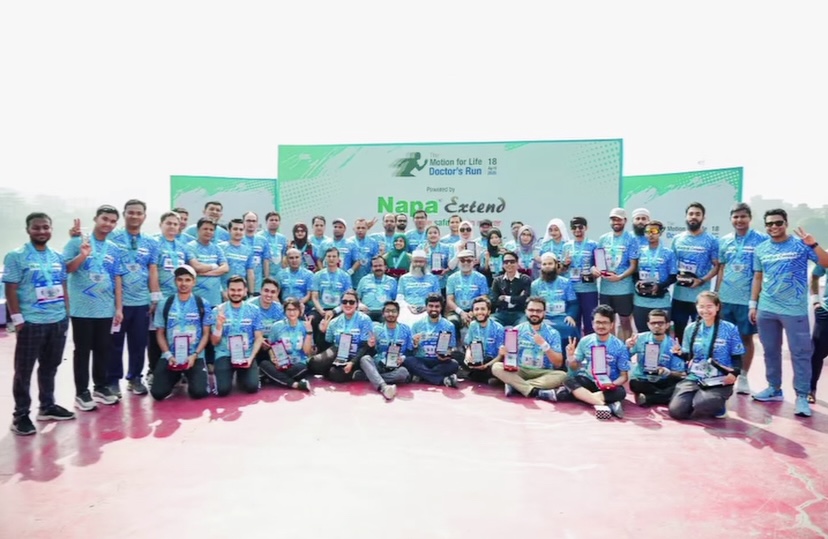
World Physical Activity Day

Our Events
Saturday
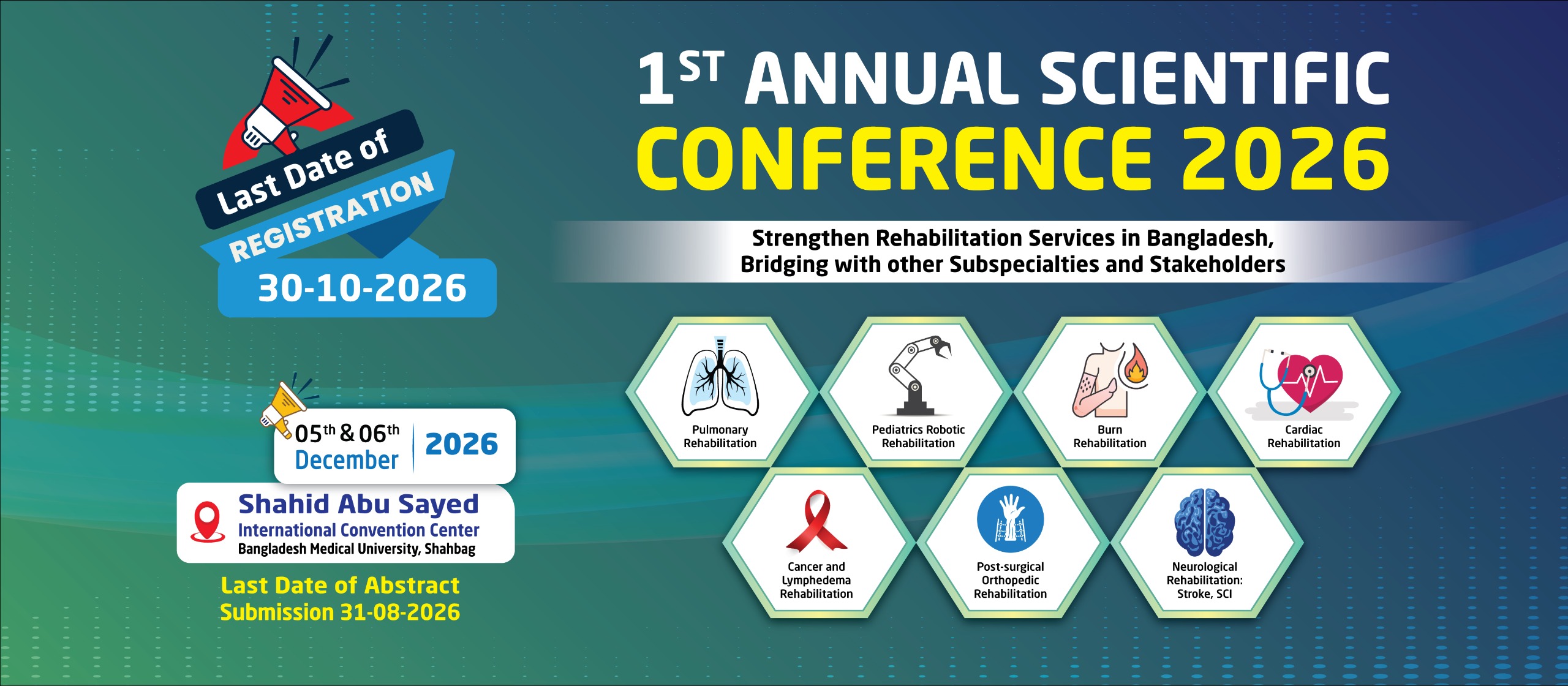
BSPMRCON 2026 of Bangladesh Society of Physical Medicine and Rehabilitation. Theme:Strengthen Rehabilitation Services in Bangladesh, Bridging with other Subspecialties and stakeholders.
Published Research
Explore our collection of verified and published research.

Dr. Md. Israt Hasan
Assistant Professor
Customized 3D-Printed Wrist-Thumb Orthoses for De Quervain's Tenosynovitis: A Prospective Observational Study
Background: Wrist-thumb orthoses are commonly used in the conservative management of De Quervain's tenosynovitis; however, conventional fabrication techniques often limit anatomical fit and patient comfort. Three-dimensional (3D) printing enables patient-specific orthosis design and may improve usability, particularly in resource-limited rehabilitation settings. Objective: To evaluate the feasibility, clinical outcomes, and patient satisfaction associated with customized 3D-printed wrist-thumb orthoses in individuals with De Quervain's tenosynovitis. Methods: This prospective observational study included 40 patients with clinically diagnosed De Quervain's tenosynovitis, of whom 37 completed a six-week follow-up. Participants received either a conventional thumb spica splint or a customized 3D-printed wrist-thumb orthosis based on feasibility and availability. Pain intensity and upper limb functional status were evaluated using the Visual Analogue Scale (VAS) and the Quick Disabilities of the Arm, Shoulder and Hand (QuickDASH) instrument at baseline, two weeks, four weeks, and six weeks. Satisfaction with the 3D-printed orthosis was measured using the Quebec User Evaluation of Satisfaction with Assistive Technology (QUEST 2.0; MARCH Laboratory (Modeling for Assistive Technology and Community Living), Centre for Interdisciplinary Research in Rehabilitation of Greater Montreal (CRIR), Montreal, Quebec, Canada). Only descriptive statistical analyses were performed. Results: Both groups demonstrated substantial reductions in pain and functional disability over time. In the conventional group, mean VAS decreased from 81.25 at baseline to 14.32 at six weeks, while QuickDASH improved from 76.25 to 16.84. In the 3D-printed group, mean VAS decreased from 75.60 to 10.07, and QuickDASH improved from 72.15 to 11.34 over the same period. Numerically greater improvements were observed in the 3D-printed group. QUEST scores ranged from 3.0 to 4.5, indicating high levels of patient satisfaction. No device-related adverse events were reported. Conclusion: Customized 3D-printed wrist-thumb orthoses are feasible and associated with improvements in pain, functional outcomes, and patient satisfaction in patients with De Quervain's tenosynovitis. Findings should be interpreted as descriptive trends, and further studies with larger samples and inferential analyses are warranted. Keywords: 3d printing; de quervain’s tenosynovitis; patient satisfaction; rehabilitation medicine; wrist-thumb orthosis.
View DetailsDr. Md. Israt Hasan
Assistant Professor
Three-dimensional printing in rehabilitation medicine: Clinical applications, implementation challenges, and future directions from a low-resource setting
Three-dimensional (3D) printing has emerged as a transformative technology in rehabilitation medicine, enabling personalized orthoses, rapid prototyping, and point-of-care device fabrication. While high-income settings report growing clinical adoption, evidence from low- and middle-income countries (LMICs) remains limited, particularly with respect to real-world implementation, interdisciplinary collaboration, and system-level barriers. Existing evidence suggests that 3D-printed orthoses are usually comparable to conventional devices in biomechanical performance, with limited high-quality evidence demonstrating clear superiority. In this narrative review, we discuss clinical applications and implementation challenges of 3D printing in rehabilitation medicine, with particular emphasis on institutional pilot experience from Bangladesh. A structured literature search (2010-2025) was performed in PubMed and Scopus using predefined inclusion criteria focused on rehabilitation-oriented additive manufacturing. Bangladesh-specific pilot cohorts were incorporated to contextualize real-world feasibility. In a prospective descriptive cohort of patients with De Quervain’s tenosynovitis (n = 17 receiving 3D-printed orthoses), no device-related structural failures or adverse skin reactions were observed during six-week follow-up. The average fabrication turnaround time was 7 to 10 days compared with 1 to 2 days for conventional splints, highlighting workflow trade-offs in resource-constrained environments. Clinical literature indicates potential advantages of additive manufacturing in anatomical conformity, weight reduction, and user satisfaction; however, implementation in tropical LMIC settings introduces material durability concerns, particularly when using polylactic acid (PLA), which may be susceptible to thermal deformation and moisture-related degradation. Successful integration, therefore, depends not only on customization capability but also on climate-appropriate material selection, interdisciplinary collaboration, and structured end-user engagement. In conclusion, current evidence suggests potential for improved usability and satisfaction with 3D-printed orthoses, while biomechanical outcomes appear largely equivalent to conventional devices in most applications. Sustainable adoption in low-resource rehabilitation systems requires embedded engineering capacity, regulatory clarity, workforce development, and user-centered co-design frameworks.
View DetailsDr. Md. Israt Hasan
Assistant Professor
Novel robotic rehabilitation in Bangladesh: A narrative review
Robotic rehabilitation has emerged as a transformative innovation in physical medicine, enabling high-intensity, task-specific, and measurable therapy that enhances neuroplasticity and functional recovery. This review summarises global evidence on robotic rehabilitation and examines its relevance and implementation challenges in low- and middle-income countries (LMICs), with a particular focus on the pioneering experience of the Bangladesh Medical University.
View Details
Dr. Fatema Newaz
Assistant Professor
Overview and Impact of Attending Training Program on “Functional Ways of Working with Cerebral Palsy Child in Low-resource Setting”
There is a lack of available services including rehabilitation intervention for children with physical disability living in rural Bangladesh. Rehabilitation in Bangladesh is not a health priority and rehabilitation teamwork has been reported to have multiple challenges including few trained rehabilitation workforce, poor inter-specialty relationships, and scarcity of assisted devices for rehabilitation.
View Details
Md. Atiquzzaman
Assistant Professor
Bangla Version of the Boston Carpal Tunnel Questionnaire: Translation, Cross-Cultural Adaptation, Validation and Reliability Assessment
Background: Self-reported instruments are outstanding predictor of symptom severity and functional status, hence represent a patient’s view and capture the full extent of disability. The Boston Carpal Tunnel Questionnaire (BCTQ) is a patient reported self-assessment tool for the peoples with Carpal Tunnel Syndrome (CTS). Objective: Our intension was to develop a reliable, validated and culturally adapted Bangla version of original BCTQ (B-BCTQ). Materials and Methods: The B-BCTQ was succeeded following a structured process that included translation, verification, compromise assessment, reverse translation, feedback, and final correction. B-BCTQ reliability and validity were conducted in 48 CTS patients. The reliability was evaluated by performing internal consistency and test–retest analyses. Its validity was assessed by comparing the B-BCTQ with the Physical functioning subscale (PF-10) of Short Form health Survey (SF-36) scale. Results: Cronbach’s alpha was 0.89 for symptom severity scale (SSS) and 0.86 for functional status scale (FSS). Also, Intra-class Correlation Coefficients (ICCs) were calculated as 0.86 for SSS and 0.91 for FSS. Pearson correlation (0.80 for SSS and 0.83 for FSS) analysis demonstrated that the B-BCTQ score was significantly correlated with the PF-10 of SF-36. All of the items were statistically significant (P<0.001). Conclusion: The B-BCTQ is successfully adapted. The study findings support the previous English version indicating its validity and reliability.
View DetailsDr. Md. Israt Hasan
Assistant Professor
Translation, cross-cultural adaptation and validation of English start back screening tool into Bangla for patients with low back pain
This study was intended to translate and culturally adapt the STarT back screening tool to produce an equivalent Bangla version. Total 58 patients with low back pain completed the newly developed Bangla version of STarT back screening tool and Bangla version of Ronald Morris Disability Questionnaire seven days apart. Reliability was assessed by internal consistency (Chronbach’s alpha for overall score 0.81 and for spychosocial subscale was 0.76) and test-retest reliability (intraclass correlation coefficient for overall score was 0.78 and for spychosocial subscale was 0.71). Reliability of Bangla version of STarT back screening tool was very good. Pearson’s correlation coefficient was carried out on the Bangla version of STarT back screening tool and Bangla version of RMDQ to assess construct validity (overall score was 0.88 and spychosocial subscale score was 0.83) which indicate a strong correlation between them. This study shows that the Bangla version of STarT back screening tool is a reliable, valid and culturally adapted responsive screening tool for the patients with low back pain.
View DetailsBecome a BSPMR Member
Join the Bangladesh Society of Physical Medicine and Rehabilitation (BSPMR) today and connect with a dynamic community of medical professionals dedicated to advancing rehabilitation science across the nation.
- Exclusive access to seminars & workshops
- Recognition & certificate from BSPMR
- Publish articles in our official portal
- Join our nationwide professional network
- Participate in national conferences
Find a Physiatrist
Search for physiatrists by location
Search Filters
Latest Published Notices
See AllAbout BSPMR
Established in 1995, the Bangladesh Society of Physical Medicine and Rehabilitation (BSPMR) is the leading professional organization dedicated to advancing Physical Medicine and Rehabilitation (PM&R) in Bangladesh. As the primary body of PMR physicians, BSPMR is committed to promoting comprehensive, evidence-based, and patient-centered rehabilitation care.
BSPMR unites specialists, academicians, researchers, and allied health professionals to enhance the quality of life for individuals with impairments, disabilities, and functional limitations. The society provides PMR-related medical education through various programs, including CMEs, workshops, fellowships, and national conferences.
BSPMR serves as a dynamic platform for knowledge sharing, professional development, advocacy, and collaborative research in rehabilitation medicine. It plays a crucial role in:
- Enhancing awareness of PM&R among healthcare providers, policymakers, and the public.
- Advocating for accessible and equitable rehabilitation services.
- Contributing to government policies for persons with disabilities.
- Catalyzing national and international collaborations to expand opportunities for members, including training, scholarships, and research.
- Liaising with the government and other agencies.
Key Objectives:
- Upholding the highest standards of PM&R practice.
- Facilitating continuous professional development.
- Encouraging clinical research and innovation.
- Fostering national and international collaboration.
- Raising public awareness about disability prevention and comprehensive rehabilitation care.
Core Activities:
- Organizing scientific conferences, seminars, and workshops.
- Publishing guidelines, journals, and newsletters.
- Providing training and capacity-building initiatives.
- Advocating for the rights of persons with disabilities.
- Supporting research and academic activities.
- Conducting community-based rehabilitation awareness programs.
BSPMR is committed to building a healthier, more inclusive, and empowered society where individuals with physical challenges receive the care, respect, and opportunities they deserve.
Join us in our mission to advance rehabilitation medicine in Bangladesh.